By Francesco Tosoni — Music Producer, Editorial Developer and Composer. Note: this article is the first in a series of editorial reflections on the music industry by Noise Symphony. Meet the team →
Why music is at risk of entering the age of the micro-right without the rules to govern it
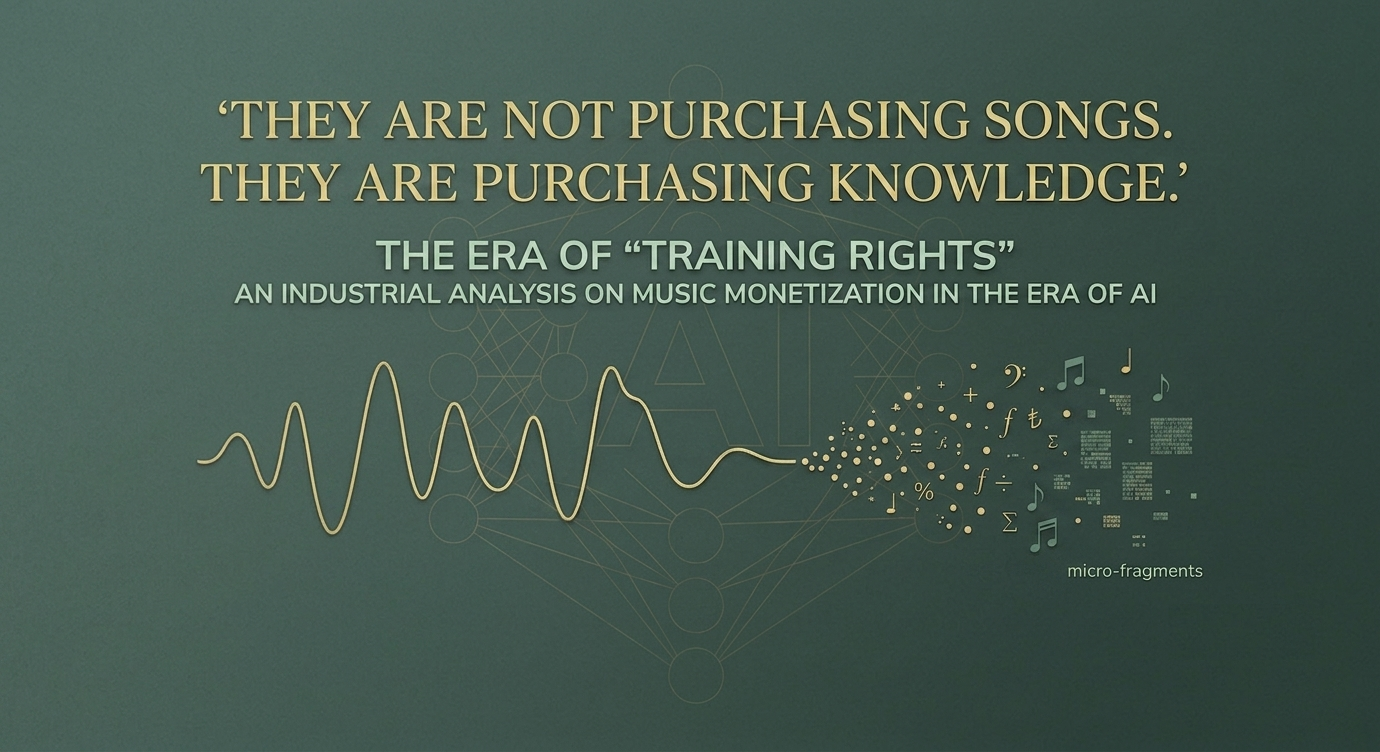
A work is no longer perceived as a song. It is being broken down. Atomized. Turned into information.
For over a century we have learned to protect a piece of music as a single, indivisible entity. A composition. A master. A recording. The entire system of copyright, neighbouring rights, collecting societies and digital distribution was built on this principle.
Today, something is changing. And the change runs far deeper than it appears.
We are not simply watching artificial intelligence arrive in music. We are watching the birth of a new economy: an economy in which value no longer sits solely in the finished work, but in its smallest elements.
The voice. The timbre. A groove. A chord progression. A stem. A sonic texture. Even the way an artist writes or phrases a line.
I write this not as a lawyer or an outside observer, but as someone who works inside the industry every day and watches this phenomenon move through contract after contract, largely undiscussed. Which is exactly why it needs a name: what has no name stays invisible.
A name for what is already happening
I propose calling it the Training Right: a new economic and contractual category the music industry will need to define — the ability to authorize, track and be paid for the use of a piece of music, or a fragment of it, as training material for an algorithmic system, regardless of whether that content is ever reproduced, broadcast or listened to.
It does not yet exist as a right recognized by any law. But the phenomenon it describes is already under way, contract after contract, and it deserves a name before someone else defines it for us.
It is a different category from anything we currently have, because it doesn’t arise from the enjoyment of the work but from its analysis. It doesn’t protect listening. It protects learning.
Training Right
a proposed category — not yet a right recognized under any law
The still-to-be-built ability of a rights holder to authorize, negotiate and be compensated for the use of a piece of music — including in fragment form (voice, timbre, groove, chord progression, stem, lyrics) — as training data for artificial intelligence systems. It would differ from copyright and neighbouring rights in that it doesn’t presuppose reproduction or public communication of the work, but its use as knowledge.
This isn’t a terminological indulgence. What has no name doesn’t enter contracts, doesn’t enter industry conversations, doesn’t enter artists’ balance sheets. And whatever doesn’t enter contracts, conversations and balance sheets ends up being decided by whoever already holds the power to decide it, without asking anyone.
They’re not buying songs. They’re buying authorizations
Over the past several months a pattern has been building that, seen as a whole, points in one clear direction. More and more platforms are asking artists to make a choice.
Do you want to authorize the use of your catalogue for AI-related purposes?
Distributors ask it. Lyrics platforms ask it. Fingerprinting companies ask it. Marketplaces and technology services ask it.
Each request, taken on its own, can look reasonable. The problem emerges once you realize these aren’t isolated episodes. They are pieces of the same mosaic.
We are building enormous archives of authorized content. We are no longer just granting licenses. We are building datasets. And that’s where everything changes: a catalogue contains works, a dataset contains knowledge.
From copyright to the training right
For decades the market rewarded distinct uses, each with its own rights holders and its own logic. When a radio station plays a song, the payment covers both copyright — handled, depending on the territory, by a national collecting society (such as PRS for Music, GEMA, ASCAP or BMI) — and the neighbouring rights of performers and producers, managed by separate neighbouring-rights societies (such as PPL or SoundExchange, depending on the country).
When a television programme synchronizes a track, copyright comes into play through an editorial negotiation — the sync — alongside, once again, the neighbouring right. When a streaming platform delivers a stream, the most economically relevant asset is almost always the master: payment goes primarily to the record label that owns it, a domain that has little to do with copyright in the strict sense.
| Right | Who typically manages it | What it compensates |
|---|---|---|
| Copyright | National collecting societies (e.g. PRS for Music, GEMA, ASCAP, BMI) | The composition: music and lyrics |
| Neighbouring rights | Neighbouring-rights societies (e.g. PPL, SoundExchange) | The performance by artists and producers |
| Master rights | Record labels (a private contractual relationship, not a collecting society) | The specific recording |
These are three distinct chains, with distinct rights holders and distinct logics, built over more than a century of rules. And it is precisely this long-standing distinction that artificial intelligence risks bypassing: a model can learn simultaneously from a composition, a performance and a master, while none of the three chains currently has the tools to intercept that use separately.
Economic value no longer arises solely from reproduction. It arises from learning. That’s an enormous difference, yet we keep discussing these phenomena using legal categories that predate the internet.
Perhaps the real issue is no longer copyright, neighbouring rights or master rights taken individually. Perhaps something is emerging that cuts across all three: a training right, one that will likely need to be administered by whoever already manages these repertoires — labels, publishers, collecting societies — but under a shared governance structure, because none of these chains can govern it alone without leaving the other two-thirds of the value uncovered.
The new economy of the fragment
Artificial intelligence doesn’t reason like a listener. It doesn’t perceive a song. It analyzes information.
For this reason, the market is starting to place value on elements that, until a few years ago, were considered inseparable from the work itself: a vocal timbre, a particular rhythmic feel, a sonic signature, a distinctive stylistic identity.
The consequence is inevitable. If economic value shifts onto the fragment, rights will have to follow that shift too.
Let’s imagine a scenario, without claiming it’s already the norm: an artist who earns almost nothing from traditional streaming could one day generate royalties every time an AI generator draws on the timbre of their snare drum, the grain of their voice, or their unique way of playing guitar to produce thousands of synthetic tracks. Today, no mechanism exists to make that visible, let alone compensable.
And here lies the question no one seems willing to address: who represents these new rights today?
The great paradox
While the private sector develops increasingly sophisticated fingerprinting, automatic identification and tracking systems, much of the infrastructure that manages music rights continues to operate according to logic designed for another century.
Innovation is running. Institutions are chasing. On one side, technologies exist that can identify micro-fragments of sound in an instant and potentially assign them economic value. On the other, many reporting processes still depend on administrative procedures, manual checks and bureaucratic workflows poorly suited to the speed of the digital economy.
This is not a criticism of collecting societies. It is the observation that the infrastructure on which we built music rights risks no longer being adequate to the new technological reality.
The risk isn’t that artificial intelligence will steal songs. The risk is that the music industry will sell off its own body of informational value without yet knowing what it’s worth.
The risk of fragmentation
There’s another aspect rarely discussed. Every platform proposes its own terms. Every distributor introduces different clauses. Every service builds its own opt-in system. Every agreement follows different rules.
Independent artists find themselves making dozens of decisions without any overall picture. Authorizing a use today could mean entering, tomorrow, entirely different technological supply chains. Not necessarily harmful ones. But certainly still poorly understood.
The real problem isn’t the existence of licenses. It’s their fragmentation.
Who will watch the watchmen?
Suppose that, in the future, every training use is genuinely compensated. That’s a positive prospect. But it immediately raises a new question.
Who certifies the uses? Who verifies the volumes? Who audits the datasets? Who guarantees that the economic distribution is transparent?
With streaming, the metric was relatively simple: the stream. With artificial intelligence, the metric becomes infinitely more complex: learning itself. It’s clear that new, shared, verifiable standards are needed.
There is also a quieter conflict at play. In some cases, the very record labels negotiating licenses with AI platforms have, or may have, direct ownership stakes in those platforms, or agreements whose contents have never been made public. That doesn’t necessarily produce harm. But it certainly casts a shadow: when the party granting access and the party receiving it are no longer independent counterparts, the rest of the market — and independent artists in particular, who don’t hold that dual position — is left without any way to verify what’s happening.
And that is exactly the kind of precedent that, left unregulated, risks becoming the rule rather than the exception.
The industry needs a steering body, not a hundred private deals
Technology is not the enemy. On the contrary: it could represent one of the greatest economic opportunities artists have ever had.
But precisely because value is shifting toward entirely new forms of use, we cannot allow the governance of these rights to emerge solely from private agreements between individual companies.
A single registry of opt-ins and opt-outs. Shared fingerprinting standards. Interoperable databases. Common rules. Independent audits. Collective bargaining for training licenses. Not to slow down innovation. To make it fair.
The question we need to ask today
In ten years we will still be talking about streaming. But we will probably be talking mostly about data. Whoever controls music data will control a significant share of the economic value of music.
That’s why the question isn’t whether artificial intelligence will change our industry. It already is.
This isn’t a battle against technology or against artificial intelligence. It’s a battle for contractual transparency. Sooner or later, artists, labels, distributors and collecting societies will need to sit at the same table to define a shared standard.
The real question is a different one. Do we want to reach that future through hundreds of private deals, each with its own rules, or build a shared system that puts artists in a position to knowingly choose how their work lives on in the age of artificial intelligence?
Because this isn’t just a question about technology. It’s about how we choose to protect the value of human creativity over the coming decades.